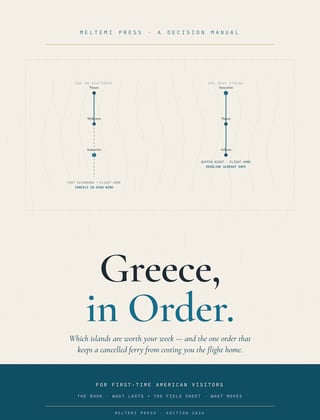
Greece, in Order.
Which islands are worth your week — and the one order that keeps a cancelled ferry from costing you the flight home.
Where a first Greek trip actually breaks
It rarely breaks on the day it goes wrong. It breaks weeks earlier, at a booking screen, in a choice that looked harmless.
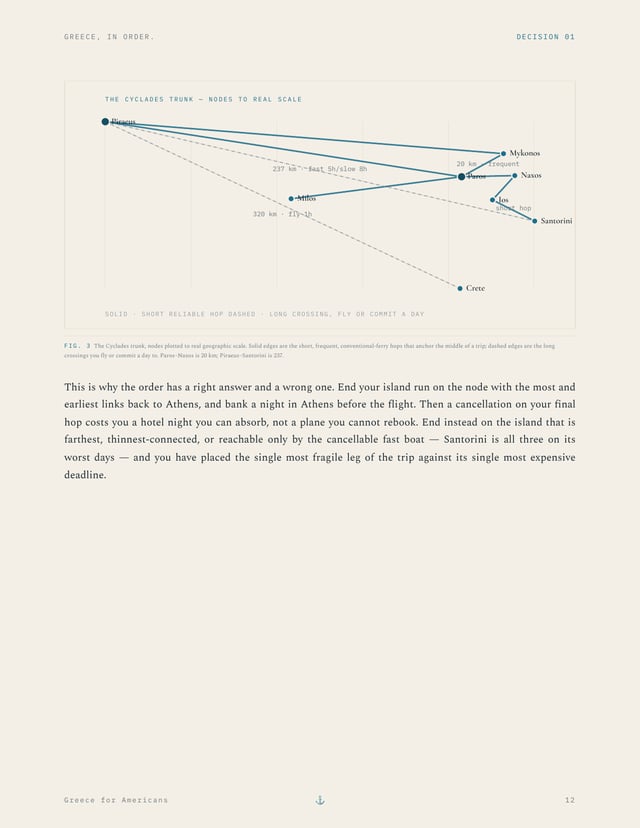
You end on Santorini because it’s the picture — the far island, the fast-boat leg, the meltemi, every fragility stacked against the one deadline you can’t rebook. You book the fast catamaran for the return because it’s quicker; it’s also the boat the wind cancels while the conventional ferry sails. You take the afternoon sailing off a long-haul arrival, and a delayed plane meets a sold-out boat at Piraeus. None of those is an exotic mistake. They are the default choices.
The free articles on this site answer each of those questions on its own. The decision manual joins them into a sequence — because the expensive mistakes live in the connections: what you book first, what that locks in, and what it quietly breaks three decisions later.
The calls it makes for you
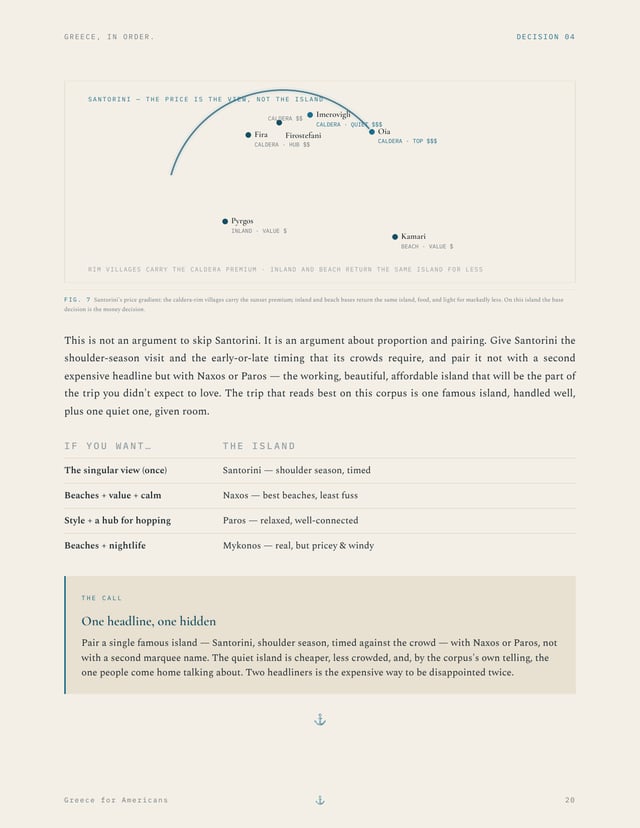
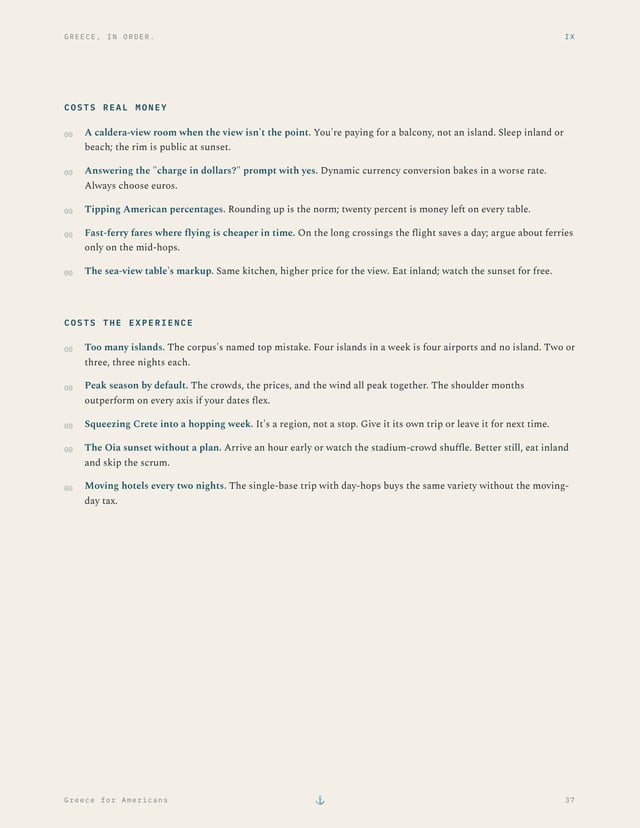
Nine decisions, each named by the question you’re actually asking — among them: which island to end on before an international flight; fast catamaran or conventional ferry on a windy leg; how many islands a week can really hold; whether Crete belongs in this trip at all; and where the first night goes when you land off a long-haul flight.
Every claim carries its provenance
Each statement in the book is marked for where it stands: structural (geography and physics — true for years), stable (the ordering or the rule holds), official (a published rule or advisory), or surveyed (our own dated observation from the corpus). No mark, no claim — anything that couldn’t be pinned was cut.
What it refuses to do
It won’t name a hotel — a specific hotel is stale within a season; what doesn’t expire is the decision of which area to sleep in, and why. It won’t name a restaurant — a named restaurant is a guess with a byline; the rule for spotting the right taverna in any village, in any year, is what travels. It won’t print current prices — a price in a book is a lie within a season. And it won’t republish anyone’s ratings — you get the reasoning to make your own call instead of someone else’s laundered scores.
If that reads as withholding, invert it: what you were spared is four flavours of confident-but-wrong.
And the numbers that move live on the Field Sheet
Fares, schedules, opening hours — the things that change with the season — sit in a short dated companion, refreshed quarterly, that you check in your travel week. The Book tells you which ferry decision to make and why; the Sheet tells you what it costs this Tuesday. When the two disagree, the Sheet is right — it was updated more recently.
See inside
The book (43 pages) + the current Field Sheet — $34, less than one mis-booked ferry leg.