Useful Greek phrases for travelers, with friendly pronunciation: greetings, please and thank you, getting around, and taverna words — and why a little Greek goes far.
You don't need to speak Greek to travel in Greece — English is widely spoken in tourist areas — but learning a handful of phrases goes a long way. Greeks genuinely appreciate visitors who make the effort, and a few words can turn a transaction into a warm exchange and unlock the country's famous hospitality. This guide covers the most useful Greek phrases for American travelers, written simply so you can actually use them, with friendly pronunciation help.
This article contains affiliate links. If you book through them we earn a small commission at no extra cost to you.
Why bother learning a few words?
English is common in Greek tourist areas, so you'll get by fine without Greek. But making the effort matters: Greeks are proud of their language and culture, and even a simple "hello" or "thank you" in Greek brings smiles and warmer service. It signals respect and curiosity, and often opens the door to the genuine, generous hospitality Greece is known for. A few words is all it takes — you don't need fluency, just willingness.
The essential greetings
Start with these everyday basics:
Yassas (yah-SAHS) — Hello / Goodbye (formal or to a group). Yassou (YAH-soo) — Hello / Goodbye (informal, one person; also "cheers" casually). Kalimera (kah-lee-MEH-rah) — Good morning. Kalispera (kah-lee-SPEH-rah) — Good evening. Kalinychta (kah-lee-NEEKH-tah) — Good night. These greetings alone, used freely, will earn you warm responses everywhere.
Please, thank you, and politeness
The magic words of courtesy:
Parakaló (pah-rah-kah-LOH) — Please (also "you're welcome"). Efharistó (ef-hah-ree-STOH) — Thank you. Efharistó polý (...poh-LEE) — Thank you very much. Né (neh) — Yes (note: it sounds like "no" but means yes!). Óhi (OH-hee) — No. Signómi (see-GHNOH-mee) — Excuse me / Sorry. The yes/no one trips up many travelers, so remember: "né" = yes.
Useful phrases for getting around
Helpful for daily situations:
Milás angliká? (mee-LAHS ang-lee-KAH) — Do you speak English? Den katalavéno (then kah-tah-lah-VEH-noh) — I don't understand. Póso káni? (POH-soh KAH-nee) — How much is it? Pou íne...? (poo EE-neh) — Where is...? To logariasmó, parakaló (toh loh-ghah-ryahs-MOH...) — The bill, please. Voíthia! (VOH-ee-thyah) — Help! These cover most practical needs when out and about.
At the taverna
For dining, a few words add to the fun:
Yamas! (YAH-mahs) — Cheers! (the toast before drinking). Kali orexi (kah-LEE oh-REK-see) — Bon appétit / Enjoy your meal. Neró (neh-ROH) — Water. Krasí (krah-SEE) — Wine. Polý oréa! (poh-LEE oh-REH-ah) — Very nice / lovely! (great for complimenting the food). Saying "yamas!" with your table and complimenting the cook will endear you to any taverna.
A few warm extras
To go a little further:
Ti kánis? (tee KAH-nees) — How are you? Kalá (kah-LAH) — Good / fine. Filoxenía (fee-lo-kse-NEE-ah) — Hospitality (a beloved Greek concept worth knowing). Kaló taxídi (kah-LOH tah-KSEE-thee) — Have a good trip. And the all-purpose "Yassas, efharistó!" (hello/goodbye, thank you) will serve you warmly in countless small moments.
Tips for using your Greek
A few pointers: don't worry about perfection — Greeks are warm and forgiving with visitors who try, and the effort counts far more than the accent. Start interactions with a Greek greeting before switching to English; it sets a friendly tone. The Greek alphabet looks unfamiliar, but you don't need to read it — these phonetic spellings get you speaking. And smile: combined with a few words, a friendly manner is the real key to connecting. Even getting it slightly wrong is endearing, so use your phrases freely.
The bottom line
A small Greek vocabulary — yassas (hello), efharistó (thank you), parakaló (please), né (yes), and a "yamas!" at dinner — is all you need to travel warmly in Greece. You'll get by in English, but the effort to speak a little Greek brings smiles, better service, and a genuine connection to the people and their celebrated hospitality. Learn a handful, use them with a smile, and watch how much warmer your trip becomes.
Reading Greek signs and menus
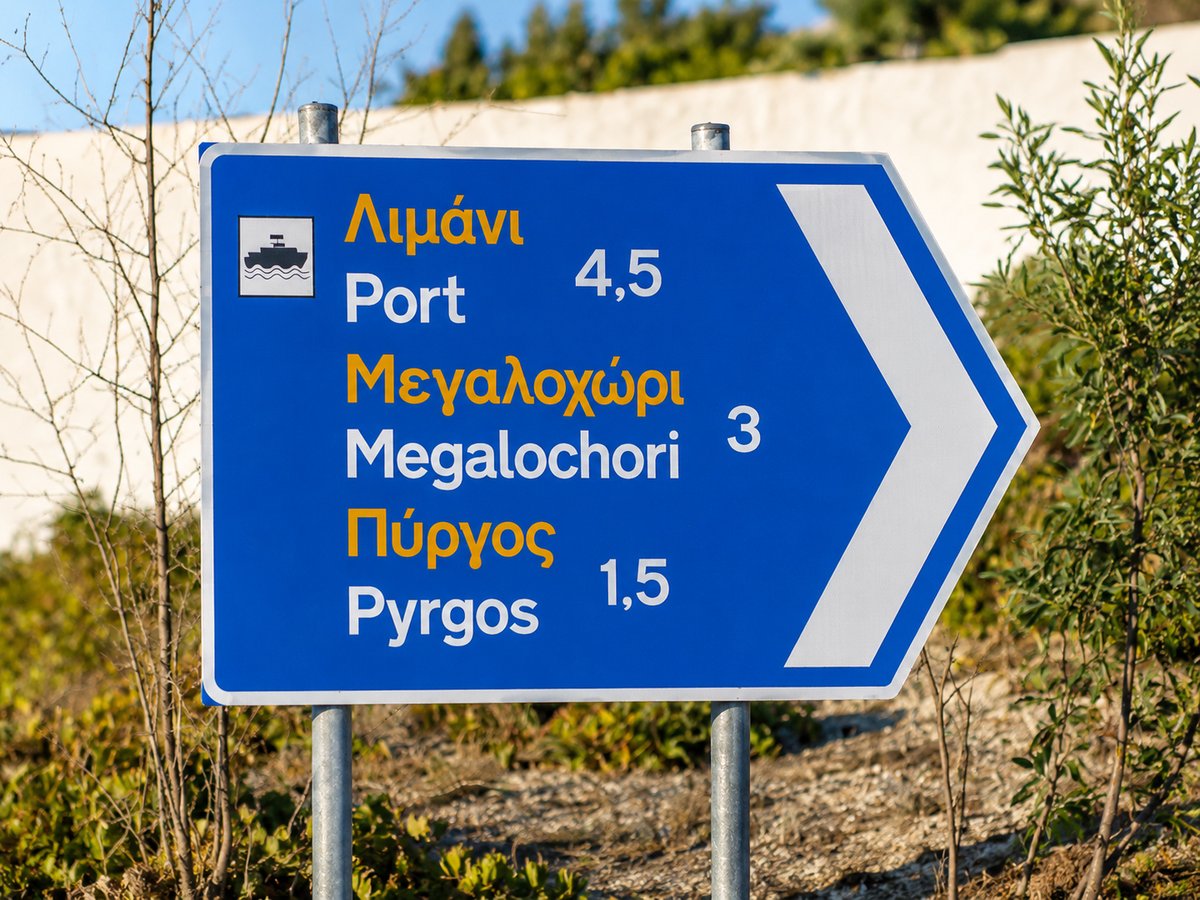
While you don't need to read the Greek alphabet to use these phrases, recognizing a few common written words helps you navigate. On signs, you'll often see ΕΞΟΔΟΣ (exodos, exit), ΕΙΣΟΔΟΣ (eisodos, entrance), ΤΡΑΠΕΖΑ (trapeza, bank), and ΦΑΡΜΑΚΕΙΟ (farmakeio, pharmacy — also marked by a green cross). On menus, knowing a few categories helps: ορεκτικά (orektika, appetizers), θαλασσινά (thalassina, seafood), κρέας (kreas, meat), and σαλάτες (salates, salads). Place names appear in both Greek and Latin letters on most road signs and transport, so you won't get lost. Many menus in tourist areas have English translations or pictures, and staff are happy to explain dishes. If you enjoy a small challenge, learning to sound out the Greek alphabet is surprisingly doable and makes deciphering signs a fun game — but it's entirely optional. The phonetic phrases in this guide are all you truly need to speak and be understood, and pointing at a menu while saying "afto, parakaló" (this one, please) works wonderfully when words run out.
FAQ
Do I need to speak Greek to visit Greece?
No — English is widely spoken in tourist areas, so you'll get by fine. But learning a few phrases like "yassas" (hello) and "efharistó" (thank you) is genuinely appreciated and brings warmer interactions.
What are the most useful Greek phrases for travelers?
Yassas (hello/goodbye), efharistó (thank you), parakaló (please), né (yes), óhi (no), signómi (excuse me), póso káni? (how much?), and yamas! (cheers). These cover greetings, courtesy, and common situations.
How do you say thank you in Greek?
"Efharistó" (ef-hah-ree-STOH), or "efharistó polý" for thank you very much. It's one of the most useful and appreciated words to learn.
What does "yamas" mean?
It's the Greek toast — "cheers!" — said before drinking. Raising a glass with "yamas!" at a taverna is a fun, friendly gesture that locals love to see from visitors.
Is it true "ne" means yes in Greek?
Yes — "né" (neh) means yes, even though it sounds like the English "no." It's a common source of confusion, so remember: né = yes, óhi = no.
Keep planning
Not sure how the islands fit together?
Pick your trip length and we'll route a real island-by-island plan — ferries included.